
Ankle pain can be caused by a variety of conditions. Athletes, including gymnasts, trail runners, soccer players, hikers, and basketball players, commonly present with ankle sprains. Other patients, usually elderly patients, may have pain because of chronic degenerative joint disease (aka ankle osteoarthritis). Often associated with arthritis, some patients may have bone cysts (bone spurs aka osteophytes) or internal scar tissue (fibrosis) that cause sharp pain. Finally, another major cause of chronic ankle pain is hypermobility or impingement of the ankle due to loose ligaments (ligament laxity) or inflammation with scar tissue in the tendons that support the ankle (tendonitis and tendinosis).
Ankle Sprains (Ligament Laxity, Hypermobility)
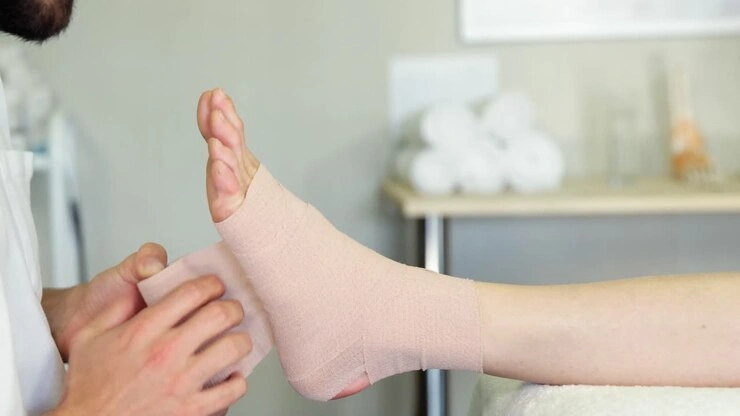
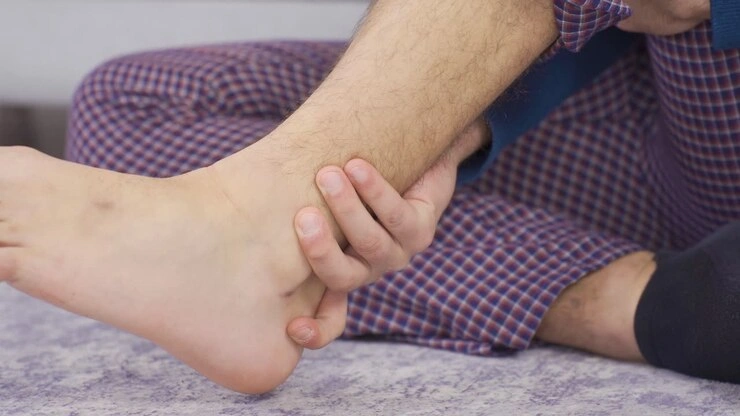
Ankle sprains usually are caused by a fall or twist usually when the body is motion such as with running, kicking, hiking, or jumping. A sprain is just the hyperextension, overstretching, or microtearing of ligaments around the front, back, or side of the ankle. The most common type of ankle sprain is one that affects the lateral (outside) aspect of the ankle. These inversion ankle sprains happen when the foot gets turned inward at the lateral ankle and usually damage the anterior talofibular ligament and the calcaneofibular ligaments.
Ankle sprains are classified into 3 major classes. 1) A grade 1 sprain is defined as mild damage to a ligament or ligaments without instability of the affected joint. 2) A grade 2 sprain is considered a partial tear to the ligament, in which it is stretched to the point that it becomes loose. 3) A grade 3 sprain is a complete tear of a ligament, causing instability in the affected joint (Sprained ankle – Wikipedia). Grade 1 and some grade 2 sprains may heal up on their own with the appropriate rest, ice, and compression. Grade 2 and 3 sprains often need further treatment to improve mobility, strength, and stability. Osteopathic manual therapy, physical therapy, ice therapy (cryotherapy), home exercises, bracing, ultrasound, dry needling, acupuncture, and active release therapy can help patients heal from these minor and more severe ankle sprains.
Prolotherapy works by causing a temporary, low grade inflammation at the injection site, activating fibroblasts to the area, which, in turn, synthesize precursors to mature collagen and thus reinforce connective tissue. It has been well documented that direct exposure of fibroblasts to growth factors (either endogenous or exogenous) causes new cell growth and collagen deposition. Inflammation creates secondary growth factor elevation. The inflammatory stimulus of prolotherapy raises the level of growth factors to resume or initiate a new connective tissue repair sequence which had prematurely aborted or never started. Animal biopsy studies show ligament thickening, enlargement of the tendinosseous junction, and strengthening of the tendon or ligament after prolotherapy injections (Alderman, 2015).
For ligament injuries of the ankle (ankle sprains), prolotherapy creates collagen growth where the injury is most acute to improve the overall stability of the ankle. Recorded in the journal Practical Pain Management, 19 patients with chronic ankle instability were treated with an average of 4.4 prolotherapy sessions. Patients had an average pain level of 7.9 on a 1 out 10 VAS (Visual Analog Scale) before receiving any injections. After their prolotherapy sessions were completed, 90% of the patients had a pain level of 2/10 or less. When these patients were asked, “has prolotherapy made your quality of life better, all of them answered ‘yes’. Also, all of these patients have also recommended prolotherapy to a friend (Alderman, 2015).*
*Results may vary; no guarantee of specific results
Ankle Osteoarthritis
Platelet rich plasma (PRP) therapy, like prolotherapy, is a method of injection designed to stimulate healing. “Platelet rich plasma” is defined as “autologous blood with concentrations of platelets above baseline levels,”20 “which contains at least seven growth factors.”21 …Activated platelets “signal” to distant repair cells, including adult stem cells, to come to the injury site (Alderman, 2015).
In very simple terms, platelet rich plasma (PRP) injections into the ankle work by placing growth factors, improving blood flow, and guiding autologous stem cells at the site to help repair collagen-based tissue such as cartilage, ligaments, and tendons. In contrast to prolotherapy, these PRP injections tend to generally cause less inflammation at the site of injection because the body does not have recruit the growth factors through cytokines (cell messengers that cause inflammation). For elderly patients and patients with advanced ankle osteoarthritis, PRP can be an effective step toward reducing their overall pain.*
*Results may vary; no guarantee of specific results
Bone Spurs, Ligament Fibrosis, and Tendinosis
Bone spurs (aka bone cysts) along with ligament fibrosis and tendinosis often occur over long periods of chronic ankle instability. After conservative therapy fails to heal an arthritic ankle joint with healthy collagen-based tissue, the body will begin to lay calcium into the tendon, ligament, or bone cysts. These calcified tissues will generally infiltrate ligamentous or tendon tissues and cause them to have a “brittle stability”. For the patient, movement of the ankle may create sharp pain that resolves after activity or becomes achy with activity. Sometimes the ankle joint or ligaments and tendons can become so brittle that the entire ankle joint is impinged. The patients body is attempting to preserve stability, but at the cost of ankle flexibility and functionality with the use of calcified bone cyst or fibrosed (scarred up) ligaments and tendons. Under the microscope, a bone cyst often looks like a porous calcified tissue (it rarely looks like solid bone-periosteum). For fibrosed ligaments and tendons, they look like twisted, knotted tissues often with calcified infiltrate under a microscope. In contrast, healthy tendon and ligaments look like long, even lines of collagen with little to none twisted or knotting.
Treatment for bone spurs, ligament fibrosis, and tendinosis in the ankle often requires the use of sophisticated osteopathic manual therapy, active release therapy, heat and ice contrast therapy, and other more aggressive manual modalities. Often, if these therapies fail, patients may consider getting injection procedures such as percutaneous curettage or tenolysis that help break down the bone spur or fibrosis. These injection therapies can be an effective option for many patients before resorting to ankle surgery.
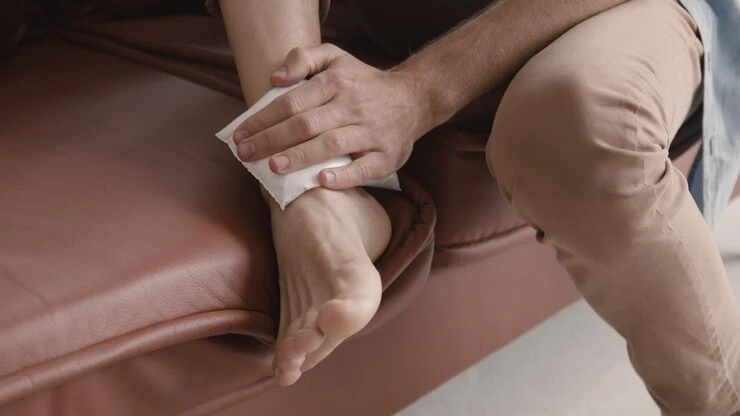
Percutaneous curettage is a procedure that involves gently scraping bone cysts (bone spurs, aka osteophytes) upon visualization with either fluroscopic or ultrasound guidance. The patient’s bone cyst is injected with a solution containing mostly local anesthetic and then the bone cyst (the consistency of a ship barnacle) is scraped away from the area of injury. In a healthy patient, the bone cyst is resorbed by the body as the body then attempts to heal the area of injury with healthy bone or cartilage. Often, the area surrounding the bone cyst is injected with either a PRP or prolotherapy solution to enhance that healing.
Similarly, tenolysis or tenotomy are procedures that can be performed percutaneously with a needle and fluroscopic or ultrasound guidance. Tenolysis just means that the tendon or ligament, after injection with local anesthetic, is gently scraped in such a way that the calcified adhesions or fibrosis is released. An analogy might be raking away spider webs from an otherwise healthy grass yard. Patients are then injected at the area of injury with either a PRP or prolotherapy solution to enhance that healing so as to prevent the reformation of that fibrosis or adhesions.
Ankle Tendonitis and Achilles Tendinopathy
Ankle Fracture
These injuries, most often diagnosed by x-rays, are best treated by immobilization and sometimes internal fixation by an orthopedic surgeon. After 1-2 years, patients who have had pins or plates put into their ankles by surgeons may require removal of that hardware upon proper fusion of the bone that was fractured. Hardware may cause long-term sharp pain.
PRP and prolotherapy may be helpful for patients who have had severe fractures due to the development of traumatic arthritis in patients with ankle fractures several years after the initial fracture. PRP and prolotherapy may be able to prevent or mitigate some of the pain associated with old ankle fractures. Percutaneous curettage can also be helpful for some of these patients who have joint impingement or bone spurs as a result of the ankle fracture or residual arthritis.
References
Alderman, D. (2015). The New Age of Prolotherapy. Practical Pain Management.
Boyette, A. & Shanahan, G. (n.d.). Usage of Platelet Rich Plasma in Foot and Ankle Pathology. Podiatry Institute.<
de Vos, R. J., Weir, A., van Schie, H. T. M., Bierma-Zeinstra, S. M. A., Verhaar, J. A. N., Weinans, H., & Tol, J. L. (2010). Platelet-Rich Plasma Injection for Chronic Achilles Tendinopathy. The Journal of the American Medical Association, 303(2), 144-149.
Gaweda, K., Tarczynska, M., & Krzyzanowski, W. (2010). Treatment of Achilles Tendinopathy with Platelet-Rich Plasma. International Journal of Sports Medicine.
Hauser, R., Hauser, M., & Cukla, J. (2012). Dextrose Prolotherapy Injections for Chronic Ankle Pain. Practical Pain Management.
Hunt, K., Bergeson, A., Coffin, C., Randall, R. (2009). Percutaneous curettage and bone grafting for humeral simple bone cysts. Orthopedics, 32(2), 89.
Platelet-Rich Plasma (PRP) Therapy. (n.d.). Retrieved March 11, 2016, from http://www.emoryhealthcare.org/sports-medicine/procedures/prp-therapy.html.
Prolotherapy for chronic ankle pain. (n.d.). Retrieved March 11, 2016, from https://www.getprolo.com/prolotherapy-chronic-ankle-pain/
Rabago, D., Slattengren, A., & Zgierska, A. (2010). Prolotherapy in Primary Care PracticeProlotherapy in Primary Care Practice. National Institute of Health. 37(1), 65-80.
Sprained ankle – Wikipedia. (n.d.). Retrieved March 11, 2016, from https://en.wikipedia.org/wiki/Sprained_ankle.
Yildirim, C., Akmaz, I., Sahin, O., & Keklikci, K. (2011). Simple calcaneal bone cysts. J Bone Joint Surg Br, 93-B(12), 1626-1631.
Contact Aspen
Integrative Medicine

BASALT:
227 Midland Ave, Suite 18B, Basalt, CO 81621
(In the courtyard between Basalt Firearms and Karen White)
Hours: Tuesday & Thursday: 12pm-5pm
Appointment required
ASPEN:
230 S. Mill Street, Aspen, CO 81611
(Above Royal Street Fine Art and Across from Louis Vuitton)
Hours: Monday, Wednesday, Friday: 12pm-5pm
Appointment required